
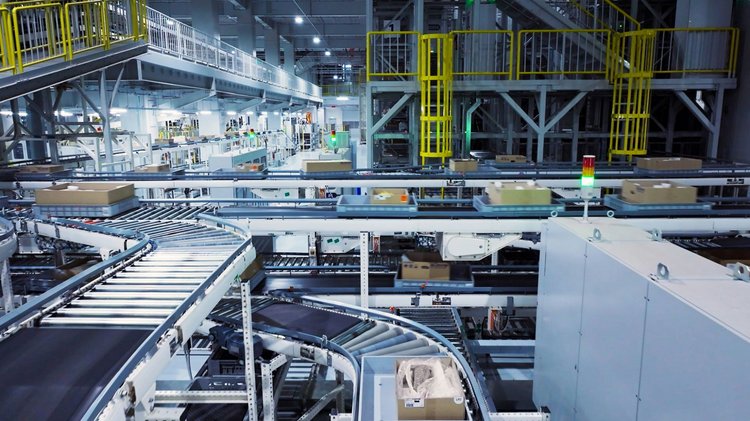
The logistics industry faces major challenges: rising energy costs, increasing sustainability requirements, and ever-growing expectations regarding speed, availability, and process reliability. At the same time, the electrification of transport, conveying, and automation solutions continues to accelerate.
Whether in autonomous transport systems, electric industrial trucks, automated conveyor technology, or mobile robotics – wherever goods are moved, drive technology plays a key role in determining efficiency, range, and overall cost-effectiveness.
Compact Drive Systems as the Key to Efficiency
In modern logistics applications, every centimeter of installation space matters. Drive systems must deliver high performance while remaining as compact, lightweight, and energy-efficient as possible. Lower weight directly reduces energy consumption – especially in battery-powered mobile applications.
Compact systems offer several advantages:
- reduced installation space requirements
- lower weight and therefore improved energy efficiency
- greater flexibility during integration
- reduced heat generation
- improved overall system efficiency
Particularly in electromobility, it is no longer sufficient to consider individual components in isolation. What truly matters is the interaction between the motor, power electronics, control system, mechanics, and energy supply.
SiC Power Electronics: Greater Efficiency with Lower Losses
One of the most important technological building blocks for efficient electric drive systems is modern power electronics. Silicon carbide, or SiC, is becoming increasingly important in this field.
SiC power electronics enable high switching frequencies while significantly reducing electrical losses. As a result, energy can be converted and utilized more efficiently. For logistics applications, this means more available power, less heat generation, and better utilization of existing battery capacity.
System size also benefits from this technology. More efficient electronics allow cooling systems to be designed more compactly, which further reduces weight and installation space. This combination makes SiC technology particularly attractive for mobile and compact drive solutions.
Lightweight Design: Less Mass, More Range
Alongside electronics, mechanical design also plays a crucial role. In electromobility, lightweight construction is not just a design trend — it is a direct lever for improving energy efficiency.
Every kilogram saved can help reduce energy consumption, extend operating times, and lower the stress placed on individual components. This is especially important in logistics, where vehicles and systems often operate continuously.
Through precisely engineered components, compact motor geometries, and carefully selected materials, drive systems can be developed that remain robust and durable without carrying unnecessary weight.
Energy Efficiency Begins with the Right Design
An efficient drive system is not created by modern individual components alone. The key lies in designing the entire system specifically for its intended application.
Torque, speed, load profile, installation conditions, ambient temperature, and operating duration all need to be perfectly coordinated. Oversized systems lead to unnecessary energy consumption, while undersized solutions can increase wear, heat generation, and the risk of failure.
That is why it is essential to consider the entire system. When motors, electronics, and mechanics work together optimally, the result is a drive solution that is not only powerful, but also economical and durable.
Logistics Requires Reliable Drive Technology
In logistics, availability is critical. Downtime costs time, money, and operational reliability. Electric drive systems therefore need to be not only efficient, but also robust, low-maintenance, and capable of withstanding continuous operation.
Maintenance-free or low-maintenance solutions offer clear advantages. They reduce service effort, minimize downtime, and improve total cost efficiency over the entire product lifecycle.
Especially in automated systems operating around the clock, the quality of the drive technology quickly becomes a decisive factor.
Compact Systems Make Electromobility More Economical
Electromobility in logistics depends on efficient, compact, and reliable drive systems. SiC power electronics, lightweight construction, and precise system design help reduce energy losses, improve range, and lower operating costs.
Companies aiming to improve efficiency in logistics should therefore not focus solely on the drive itself, but on the entire system. True efficiency is achieved when electronics, mechanics, and application work together seamlessly.
Looking for a compact, energy-efficient, and durable drive solution for your logistics application? We develop the right solution for your requirements.