Materials of the Future

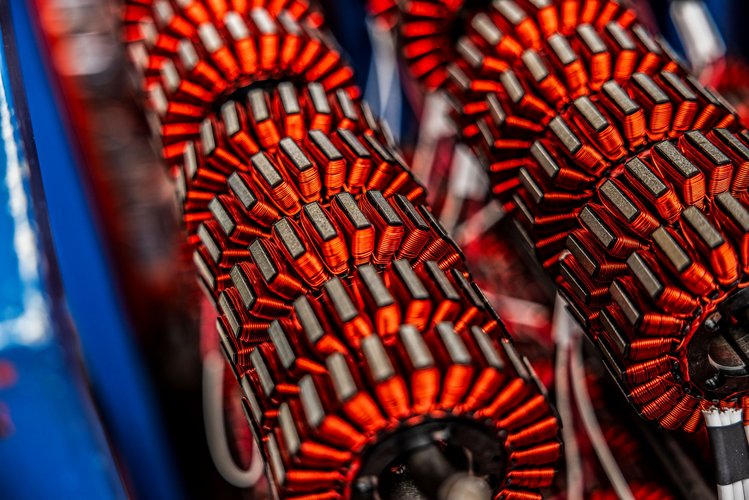
Coil production at Kern Motion Technology

How New Materials Are Changing Drive Technology.

New and advanced material solutions expand design possibilities. Their potential is realized through the interplay of design, manufacturing, and operating conditions.

In drive technology, the choice of a material influences far more than just the weight and strength of a single component. Among other things, it affects thermal management, damping, wear, installation space, manufacturing processes, and service life.

Therefore, the material alone is not the decisive factor. Material, design, manufacturing, and operating conditions must be considered together. This applies to well-known materials as well as to advanced material types and new material combinations.

High-Performance Plastics: New Applications for Load-Bearing Components

Thermoplastics are already being used in drive technology today. Thermoplastic gears are a concrete example of this. High-performance thermoplastics such as PEEK are expanding the range of applications for polymer components to include higher mechanical and thermal stresses.

Depending on the application, low density, corrosion resistance, electrical insulation, or damping can offer advantages. Processes such as injection molding also enable complex geometries and functional integration. At the same time, temperature, stiffness, load-bearing capacity, wear, heat dissipation, load profile, and service life must be suited to the specific application.

Therefore, a metal component cannot simply be replicated in plastic with identical geometry. Wall thicknesses, component design, and specifications must be adapted to the material’s behavior. Only a design tailored to the material’s properties can unlock the potential advantages of polymer components.

TPE: New Possibilities for Flexible Couplings

Thermoplastic elastomers combine elastic properties with thermoplastic processability. This makes them of interest for components subjected to dynamic loads as well.

For example, their potential use in elastic couplings—which are employed, among other things, to control vibrations and torque spikes in the powertrain—is being investigated. Key factors here include dynamic tensile and compressive loads, creep behavior, and processability.

TPEs are therefore not a universal substitute for established elastomers. The decisive factors are how the material behaves under real operating conditions and whether it is suitable for the specific application.

Materials research makes materials more predictable

Good material properties alone are not sufficient for a robust design. Developers must also be able to estimate how a component will behave under varying temperatures and loads over its service life.

Current research therefore considers material, manufacturing, geometry, temperature, and load collectively. One example is the fatigue strength database for thermoplastics developed by Fraunhofer LBF, which was introduced in 2026.

Such data provides a better foundation for simulation, sizing, and service life assessment. This allows for a more sound design of different component geometries under real operating conditions.

Multi-material: The Right Material in the Right Place

Future material solutions therefore do not necessarily have to be based on a single material. Increasingly, the focus is on selectively using different materials according to their respective functions and combining them with one another.

Multi-material concepts follow precisely this principle. In such stator designs, for example, material distribution, geometry, technical requirements, and the manufacturing process are considered together. The central question is thus less “metal or plastic?” and more about which material best fulfills the respective function at each specific location.

The choice of material starts with the application

The choice of material depends on the load profile, temperature, installation space, dynamics, and manufacturing process. Therefore, material selection should be considered early in the design and engineering phases.

Do you need a custom drive solution for specific technical requirements? Kern Antriebstechnik develops and manufactures motors, brakes, and clutches tailored to the respective application. Design, materials, manufacturing, and operating conditions are all factored into the overall technical design.

Write to us