
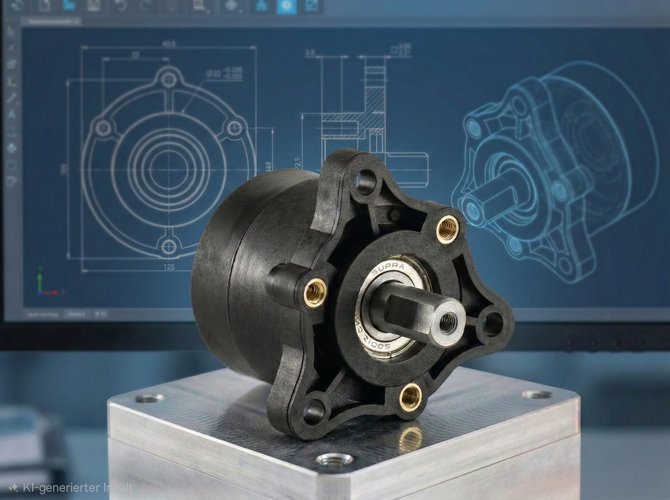
Increasing power densities, more compact designs, and higher demands for energy efficiency and dynamics are fundamentally changing product requirements.
For us at Kern Antriebstechnik, this means that couplings are now far more than simple connecting elements. They are functional system components with a direct impact on the efficiency, safety, and service life of a drive system.
Classic non-switchable couplings
Non-switchable couplings have been an integral part of industrial drive systems for decades. They permanently connect two shafts and transmit torque without backlash, either torsionally rigid or torsionally flexible.
Typical designs are:
- Claw couplings
- Bellows couplings
- Elastomer couplings
Their strengths lie in:
- High operational reliability
- Low-maintenance design
- Compensation of misalignment
- Compact design
- Good damping properties ( in elastic variants)
These couplings perform their task reliably in numerous applications. However, with increasing dynamics, more sensitive control technology, and increasing electrification, purely mechanical solutions are reaching their limits.
Technological progress: Adaptive clutch systems
With the advance of digitalization, a new stage of development is beginning in clutch technology. Adaptive systems actively respond to changing operating conditions and adjust their transmission behavior in real time.
Unlike purely mechanical couplings, they integrate:
- Sensors
- Electronic control units
- Electromagnetic or fluid-based operating principles
This enables, among other things:
- Dynamic torque adjustment
- Active overload protection
- Targeted vibration reduction with changing loads
- Optimized energy transmission
In addition to increased performance, adjacent components also benefit from the reduced mechanical load. Adaptive coupling solutions offer technical advantages, especially in applications with highly variable load profiles – such as in robotics, e-mobility, or high-precision positioning systems.
Development prospects
The future of coupling technology lies in systemic integration. Mechanical precision remains the foundation—supplemented by sensor technology, data analysis, and intelligent control strategies.
Mechanics alone are no longer sufficient in highly dynamic applications. Only the interplay of robust construction, well-thought-out system design, and intelligent control creates solutions that are both powerful and adaptable.
Are you looking for a coupling solution that is precisely tailored to your application? We would be happy to advise you and work with you to develop the right drive solution.
Contact us now